
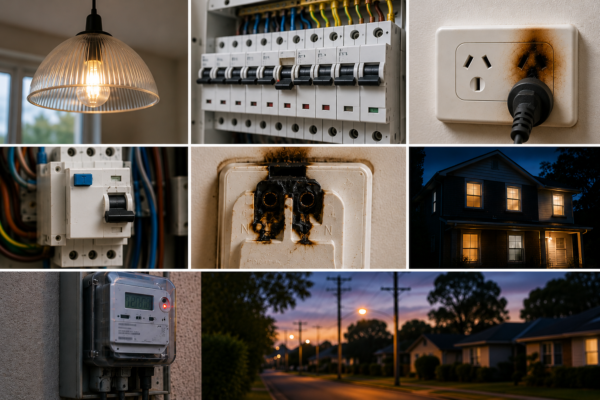
Electrical systems work quietly in the background every day, so it’s easy to overlook small changes when something isn’t operating quite as it should.
A light that flickers occasionally, a circuit breaker that trips now and then, or a power point that feels warmer than usual might not seem like a major concern at first. However, these types of issues can sometimes indicate underlying electrical faults that become more noticeable over time.
Identifying problems early can help improve electrical safety, reduce the risk of unexpected power outages, and prevent minor faults from developing into larger repairs.
Here are seven common electrical problems homeowners shouldn’t ignore and what they might be telling you.
A loose globe can cause an occasional flicker, and that’s usually nothing to worry about. But if lights are flickering or dimming regularly, particularly across multiple rooms or fittings, there’s likely something more going on.
Common causes include:
If the flickering happens when a specific appliance switches on, such as a heater or air conditioner, that can point to voltage drop under load. Our post on winter power demand and your electrical system covers this in more detail.
Circuit breakers are designed to disconnect power when a circuit is overloaded or a fault is detected. The occasional trip isn’t unusual, but repeated tripping on the same circuit is the system telling you something needs attention.
Resetting the breaker restores power temporarily, but it doesn’t fix the underlying issue. Common causes include:
Running a heater, air conditioner, and several other appliances from the same circuit simultaneously is one of the more common causes, particularly in older homes.
If you’re not sure whether a tripping breaker is an urgent issue or something that can be scheduled, our guide on when an electrical issue is an emergency can help you work out the right next step.
Power points shouldn’t become warm during normal use.
If a power point feels noticeably warm to the touch, shows discolouration, burn marks, or gives off an unusual smell, those are signs of a problem that should be looked at promptly.
Warm outlets usually indicate overheating electrical components or a loose connection behind the power point. Loose connections create resistance, resistance creates heat, and sustained heat can become a fire risk over time.
If the power point is showing visible damage or the smell is persistent, switch off the circuit at the switchboard if it’s safe to do so and arrange an inspection.
Safety switches work by detecting electrical faults and cutting power immediately, protecting against both fire and electrical shock.
The NSW Government reports that around 40% of house fires in NSW each year are caused by electrical faults and appliances, and that many of these could be prevented by having safety switches installed by a licensed electrician.
If a safety switch trips once after plugging in a specific appliance, that appliance is usually the culprit and worth testing or replacing. But if a safety switch trips repeatedly or can’t be reset at all, there’s an underlying fault somewhere on the circuit that needs to be found.
Common causes include:
Repeatedly resetting a tripping safety switch without identifying the cause isn’t a solution, it simply delays the problem and increases the risk.
A burning smell near a switchboard, power point, light fitting, or appliance should always be taken seriously.
Electrical components can overheat when connections become loose or equipment begins to fail, and a burning smell is often one of the first warning signs.
Other signs to watch for include:
If any of these signs are present, switch off the affected circuit if it’s safe to do so and contact a licensed electrician.
Power that cuts in and out without warning can be frustrating because the cause isn’t always obvious.
In some cases, the issue is within the property’s electrical system. In others, it may involve the supply connection between the street network and the property.
Possible causes include:
If the loss affects the whole property or occurs without any obvious pattern, it may be a supply-side issue rather than an internal electrical fault.
Where faults involve service mains, metering equipment, overhead power connections, or underground supply cables, a Level 2 ASP electrician may be required. Our guide on who is responsible for electrical supply issues in NSW explains how that boundary works.
A sudden jump in your power bill isn’t always caused by using more electricity.
Faulty appliances, ageing hot water systems, electrical faults, or equipment operating inefficiently can all contribute to increased power consumption without any obvious change in household habits.
Hot water systems are one of the most common contributors, particularly older systems with failing elements that run longer to reach temperature. According to Energy NSW, water heating accounts for a significant share of the average household’s electricity use, so a system that’s not running efficiently has noticeable impact on your bill.
If your electricity usage increases significantly without a clear explanation, our post on why your power bill keeps going up covers the most common electrical causes in detail.
Most electrical problems start with small warning signs before developing into larger faults.
Flickering lights, repeated tripping, burning smells, intermittent power loss, or warm power points are all issues worth having assessed sooner rather than later. Identifying faults early can help prevent larger repairs, improve electrical safety, and reduce the risk of unexpected power outages.
Troy and the Powellect team bring over 40 years’ experience working across homes, businesses, strata properties, and industrial sites throughout the Newcastle, Lake Macquarie, Port Stephens. and the Hunter region.
If you’ve noticed any of the signs above and you’re not sure what’s causing them, it’s worth getting them checked. Most electrical problems are straightforward to diagnose once a licensed electrician is on site.
Contact us to book an inspection or get advice, or call any time for 24/7 emergency support. You can also view the full list of areas we service across the Hunter Region.