
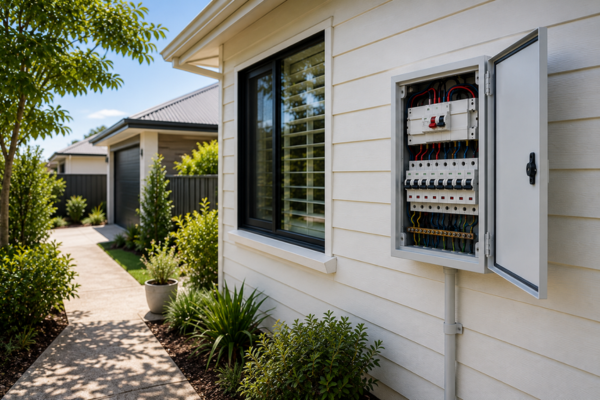
Your switchboard is one of the most important parts of your home’s electrical system. It distributes power throughout the property and contains the protective devices that help safeguard your circuits from overloads and electrical faults.
Many homes across Newcastle, Lake Macquarie, Port Stephens, Maitland and the Hunter Region still have switchboards that were installed decades ago. While they may still be operating, they weren’t designed for the way most households use electricity today.
If you’ve noticed repeated tripping, you’re planning renovations, or your switchboard still contains older equipment, it may be time to have it assessed. Understanding the warning signs can help you decide when to act. For a broader look at common electrical issues, our post on electrical problems homeowners shouldn’t ignore covers several related faults in more detail.
Every electrical circuit in your home begins at the switchboard.
A modern switchboard contains protective devices that monitor each circuit and disconnect power if an overload or electrical fault is detected. According to the NSW Government, older homes may only have a single safety switch protecting several circuits, which leaves parts of the property without adequate protection. A properly upgraded switchboard addresses this by ensuring each circuit has its own protection.
Depending on the installation, a modern switchboard may include:
Together, these components help improve electrical safety, protect appliances, and reduce the risk of damage caused by electrical faults.
Circuit breakers are designed to trip when they detect an overload or fault. The occasional trip isn’t necessarily a problem, but if the same circuit keeps tripping, or multiple breakers are operating regularly, it’s usually a sign that something needs attention.
Sometimes the issue is an overloaded circuit or faulty appliance. In other cases, it may indicate that the switchboard is struggling to support the electrical demand of the property.
If you’re resetting the same breaker repeatedly, it’s worth having the cause investigated rather than simply restoring the power each time. Our guide on common electrical problems explains what repeated tripping usually means and when to call an electrician.
Many older homes still have ceramic fuse boards. While ceramic fuses were common for many years, they don’t provide the same level of protection or convenience as modern circuit breakers and safety switches.
If your switchboard still contains ceramic fuses, it doesn’t automatically mean it’s unsafe. However, it’s a good opportunity to have the switchboard inspected and discuss whether upgrading would improve the safety, reliability, and functionality of your electrical system.
Homes with ceramic fuses can also lack safety switches entirely, which means there’s no protection against electric shock if a fault develops on a circuit.
The average home uses far more electricity today than it did when many older switchboards were installed. Air conditioning, induction cooktops, electric vehicle chargers, workshops, pools, home offices, and home entertainment systems all increase the demand placed on the electrical system.
If your household has gradually added more appliances over the years but the switchboard has never been upgraded, it may no longer be suited to the way the property is used today. This is one of the issues covered in our post on why your power bill keeps going up, where circuits running close to capacity are a common contributor to both faults and higher energy costs.
A switchboard upgrade isn’t always the result of an electrical problem. If you’re planning to add new electrical systems or significant appliances, your electrician may recommend upgrading the switchboard first to ensure it has the capacity and protection required for the additional load.
This commonly applies to:
Where a switchboard upgrade connects to the supply side of the system, a Level 2 ASP electrician may be required in addition to a general electrical contractor. Our guide on Level 2 electricians and your power supply explains when Level 2 work is needed and what it involves.
As homes evolve, additional electrical circuits are often needed for renovations, new appliances, or outdoor power. Older switchboards can eventually run out of space for extra circuit breakers or protective devices.
If your switchboard has reached capacity, replacing it is often the most practical long-term solution rather than trying to modify ageing equipment. A new switchboard can be sized to accommodate your current needs and leave room for future additions.
Visible damage should never be ignored. Burn marks, rust, corrosion, cracked components, signs of overheating, water ingress, or loose fittings can all indicate that the switchboard requires professional attention.
These issues don’t always mean the entire switchboard needs replacing, but they should be inspected promptly to determine the cause and the most appropriate solution. A switchboard showing visible signs of heat damage in particular should be treated as urgent.
Not necessarily. The age of a switchboard alone doesn’t determine whether it needs to be upgraded. Some older switchboards continue to operate reliably, while others may no longer be suitable because the property’s electrical demand has increased or additional protection is recommended.
The only reliable way to know is to have the switchboard professionally assessed. An inspection gives you a clear picture of the condition of the equipment, whether it’s adequate for your current needs, and what, if anything, needs to be done.
A switchboard inspection allows an electrician to assess both the condition of the equipment and whether it’s suitable for the property’s current electrical requirements.
This typically includes checking:
Following the inspection, you’ll have a clear understanding of whether maintenance, repairs, or a complete switchboard upgrade is the right next step.
Troy and the Powellect team bring over 40 years’ experience working across homes, businesses, strata properties, and industrial sites throughout Newcastle, Lake Macquarie, Port Stephens, Maitland, and the Hunter Region. Powellect carries out switchboard inspections and upgrades for residential and commercial properties, and where a switchboard upgrade also requires Level 2 ASP work, the accredited team can complete the entire project from start to finish.
If you’re experiencing repeated tripping, your home still has ceramic fuses, or you’re planning a significant electrical addition, it’s worth arranging a professional assessment before the issue develops further.
Contact us to book a switchboard inspection or get advice or call any time for 24/7 emergency support. You can also view the full list of areas we service across the Hunter region.